
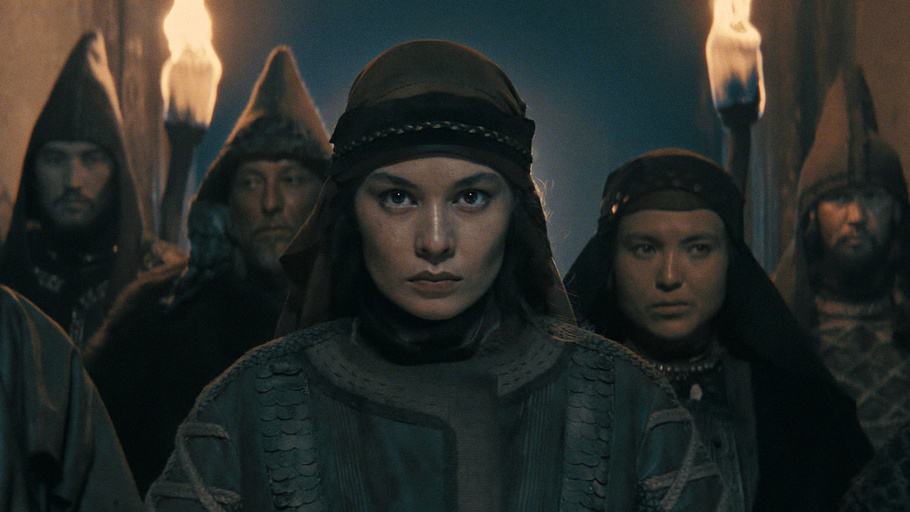
This post is for the purpose of recommending the movie, The Legend of Tomiris. It was a movie released in 2019 with English subtitles. It was an Asian movie and you will not recognize the actors credited in the movie. It was originally released in three languages: Turkish, Russian and Kazakh. I did not learn about this movie myself. A friend sent me a copy of the Blue ray/DVD version of the movie. It tells the story of the famous Queen Tomiris (also spelled Tomyras) who led the Massagetae, a large tribe of the Saka confederation who were anciently spread from the Black Sea to the region of the Aral Sea deep into Asia. The first link offers some brief information about Queen Tomiris, about whom I wrote in a blog post in 2013. That post was in response to a claim that her tomb had been found in Central Asia. That referenced link is no longer active, but you will be able to obtain in the first link an introduction to information about Queen Tomiris and her defeat of King Cyrus of the Persian Empire in 528 BC (according to the Encyclopaedia Britannica, 1943 Edition) or 530 BC (according to the book, The Medes and Persians by William Culican).
The second link offers a wealth of information and perspectives about Queen Tomiris. Her primary ancient biographer was Herodotus, a famous Greek historian. The second link lists other ancient Greek and Roman historians who wrote about Queen Tomiris and her successful war against King Cyrus of Persia. The second link offers accounts by proponents and skeptics about the ancient historians’ accounts of Queen Tomiris’ life. However, I think that it can be accepted that the ancient writers, who lived circa 2,000 or more years prior to modern skeptics, were so much closer to the time of Queen Tomiris’ life that they are going to be more accurate in their accounts about her. The ancient historians also, no doubt, had access to written accounts about the life of Queen Tomiris that have long since perished over time. I discuss Queen Tomiris and the Scythians at length in my book, Israel’s Lost Empires, and in my E-book, The “Lost” Ten Tribes of Israel…Found! Both are available at the home page of my website, stevenmcollins.com.
The movie uses actors reflecting the ethnic populations now inhabiting modern Central Asia. In Queen Tomiris’ time, the ethnicity of the Central Asian populations would have been much different. Queen Tomiris ruled the Massagetae, one of the larger tribes of the Saka/Scythian confederation. The Scythian tribes were Caucasians except for a few local groups. They did not enter the steppes from Siberia as some assert. They were civilized and were exceptionally skilled in gold-smithing. Indeed, it is their gold artwork which survives into today’s era that confirms their racial origins. Their gold artwork and ornamentation show the Scythians’ male self-depictions to be of bearded Semites. The pictorial book, Scythian Art, by Boris Piatrovsky, Liudmila Galanina and Nanna Grach, has numerous reproductions of Scythian artwork in gold objects showing the clear depictions of Scythian males as Semites/Caucasians. The skill of their artwork is incredible and, in my opinion, it equals the artwork of the Greco-Roman world.
The Bible and history record that the Israelites of biblical times went into exile in the late eighth century BC. Many were taken into captivity in Central Asia and the Medo-Persian region on the coasts of the Caspian Sea, a fact mentioned in II Kings 17:5-6. II Kings 17:18 asserts all the northern tribes were exiled from the Promised Land by the time frame of 732-721 BC except for the tribe of Judah, which remained until the sixth century BC in its homeland with Jerusalem as its capital. The Scythians ruled over later by Queen Tomiris were descended from this mass of Israelite captives who later became independent after their Assyrian and Babylonian captors had their empires collapse and the Israelites escaped to the steppes. My books assert the Scythian Massagetae were the Israelite tribe of Manasseh. God had promised King David that his descendants would always have rulers reigning over the ten tribes of Israel (II Samuel 7:8-16, Jeremiah 33:17). The consonants of Queen Tomiris’ name are T-M-R with a suffix of “-is.” Vowels were often not written in ancient languages and were interchangeable. King David had a famous royal daughter named Tamar who was raped by a half-brother and avenged by another brother (II Samuel 13). Queen Tomiris bore the name of King David’s daughter, Tamar. David was a warrior king, and Tomiris was a warrior Queen–true to her descent from King David. That Tomiris bore the name of a famous royal daughter of the dynasty of King David while ruling over descendants of the ten tribes of Israel was a fulfillment of God’s promise to King David cited above and further evidence that the Massagetae were the descendants of Israelites who had been taken captive a few generations prior to her life. All the “Sacae/Saka” tribes bore the name of “Isaac/Yitsaak;” a fulfillment of the prophecy in Genesis 21:12 that Abraham’s birthright seed would bear the name of “Issac/Yitsaak” upon them as an identifier.
The descendants of the ten tribes who went into exile into Asia became very numerous in their new homelands as they became known as individual tribes within the overall Scythian/Saka confederation. This also was prophesied. In Hosea 1:4-5, God adamantly declared that he was about to send the inhabitants of the northern ten tribes of Israel into exile from the Promised Land, but he makes it clear that he will still honor the birthright blessing that was first given to Abraham and then to Isaac, Jacob/Israel and, finally, to Joseph’s sons Ephraim and Manasseh. In Hosea 1:10, God prophesies that the exiled descendants of the ten tribes will have their future progeny increased in numbers to be essentially uncountable. Their numbers had been vastly increased by the time Queen Tomiris led many of them to defend their homeland from an invasion by the Persian Empire under King Cyrus the Great (who perished in that war vs. the Scythians). Much more information about the Scythians, Saka and Massagetae are included in my aforementioned books which can be obtained at the home page of my website.
The great battle between the Persian Empire and the Scythian confederation was an immense battle. Herodotus, the famous Greek historian who lived perhaps two centuries after the Persian-Massagetae war occurred, wrote that “Of all the battles that were fought among the barbarians, I judge this to have been the severest, and indeed my information is that this is so. (The History, Herodotus, I, 214).” Herodotus manifests a Greco-centric perspective by calling the Persians and Scythians “barbarians,” but his observation is quite telling. In referring to contemporary “information” that was available to him, he acknowledges that there were other historical records available to him about Queen Tomiris, the Scythians and Persians that he does not name.
The movie, The Legend of Tomiris, was released in 2019 by Staifilm, LLP and Well Go USA Entertainment. I did a web search to seek to give readers ways to obtain the movie, and found a source which offers viewers a link to watch the movie for free. That source and the free link to the movie are in the third link. I hope that link is still active. Set aside some time to watch it as it is about two and one-half hours long. It covers the entire life of Tomiris from an orphaned childhood to her warrior training and her ultimate role as Queen of a huge tribe of Scythians who defeated Cyrus the Great when he invaded Scythian territory. The movie benefits from some high-tech additions. In depicting the battle, the movie includes some scenes offering a perspective on how the battle looked if it had been seen from a high-altitude drone. Obviously, there were no such drones in the sixth century BC when the battle was fought, but it does add to one’s understanding of the tactics being used by both sides.
- https://stevenmcollins.com/
tomb-of-sakascythian-princess- found-new/ - https://iie.kz/?p=25974
- https://www.google.com/search?
client=firefox-b-1-d&q=MOvie% 3A+The+Legend+of+Tomiris
