
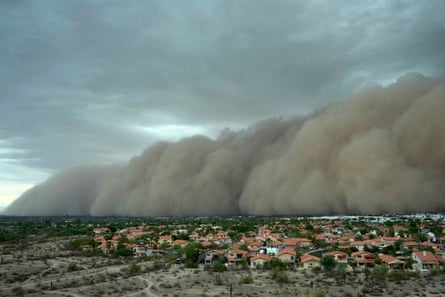
My previous post was about the expanding Mega-drought that is scorching the American Southwestern states. That post warned that if the climatologists are correct, the effects of the Mega-drought would steadily worsen. As if on cue, a massive dust storm soon struck and enveloped Phoenix and the region around that city.
The first link, second link and third link contain the very impressive views of the expansive wall of dust as it approached the city of Phoenix. Also shown is how visibility was affected as the dust storm was filmed at a sports stadium. Besides showing the expansive brown wall of dust approaching Phoenix, the links also report that the Phoenix airport had to be shut down for obvious reasons. Power outages also affected thousands of residents. It is also mentioned that in such a severe drought, flash floods can result from sudden rainstorms. Surprisingly to some, a flash flood in the desert often does not relieve a drought. The ground surface can be so hard that it takes on an impermeability that in my Midwest region is called hard pan soil. Swiftly-flowing water just flows over the hard pan into dry riverbeds and onward to large rivers that take the water to the sea. A good biblical description of hard pan soil is found in Deuteronomy 28:23 where God states he can turn the climate so dry from drought that the soil people walk on will become like “iron.” If the Mega-drought continues, dust storms like the one that struck Phoenix may become more frequent events.
I recall as a child growing up listening to my Mom tell about the dust storms and other hazards which affected South Dakota during the “Dirty Thirties” depression in America’s midsection. As a girl, she experienced dust storms which lasted days, not mere hours. Drifts of dust would form around window sills and doorways as it was impossible to keep the dust out of the farm buildings. She grew up on a farm and it was very hard to care for livestock during the most blinding storms. Her father would have to tie rope-lines from their house to the barn, chicken coop, etc, so they could feed and care for the cattle, sheep and chickens they raised. They used the same rope-lines in winter during blizzards. Besides dust storms, farmers in the Dust Bowl days also had to contend with locust swarms that consumed vegetation above ground. Such locusts were a regular hazard for years so her parents planted huge gardens with many tuber crops (potatoes, beets, carrots, radishes, etc.) which matured below ground so the locusts would not eat them. My mother recollected how they survived some winters eating off the vegetables they could save, the milk and meat from livestock and eggs from the chickens. There is no mention of locust swarms in the links below and it is possible that locust swarms would not invade deserts as there is not enough greenery to sustain a swarm. However, if the Mega-drought expands its range to more states in future years, such swarms may again make an appearance. Today’s generations have no idea of what it is like to work hard simply to survive. If the Mega-drought expands and lasts for years, modern generations may yet have to learn essential survival skills.
Wildfires are also a major risk during droughts, and the Western portion of America is having them in many states. Canada is having many wildfires which seem to now be annual events in the summer. The fourth link is devoted to covering a current wildfire in the California wine country.
My previous post cited the biblical warnings that God will eventually lose patience with people who rebel against his ways and he will pour out “curses” on their land. Deuteronomy 27-28 discuss the blessings for national obedience and the cursings for national disobedience in considerable detail. I suggest readers consider the lesson contained in Amos 7:1-6. In this passage, God confided to the Prophet Amos that he was about to bring two national plagues on the ancient northern Kingdom of Israel. Amos immediately entreated God to have mercy on the people of Israel and spare them the afflictions that God had just pronounced on them. Amos was just one person, but his intercessory prayer saved the kingdom from those two pronounced plagues. James 5:17-18 also tells us the prayer of just one person can have a huge effect. God says he “changes not” (Malachi 3:6), so we can individually (or collectively) intercede for our nations today and ask God to spare our peoples or at least lessen the effects of national curses that may come in the future during the latter days of our current age.
- https://www.youtube.com/watch?
v=LPugKdoFbQ0 - https://www.youtube.com/watch?
v=kZn1uDhwmkU - https://www.pbs.org/newshour/
nation/massive-dust-storm- rolls-through-metro-phoenix- leaving-thousands-without- power - https://www.bbc.com/news/
videos/cwy3m7z7emko
