
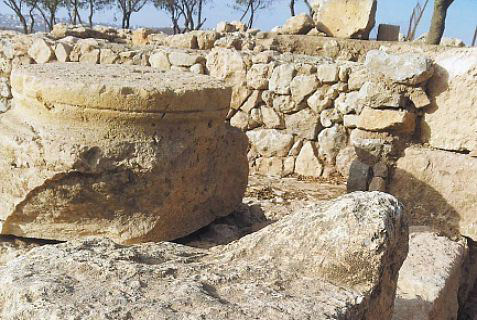
In the midst of major events happening in the modern world which are consistent with biblical prophecies for the latter days, I think it is good to bring to readers’ attention to important discoveries as they occur in the Holy Land. Recent discoveries at an archaeological dig at the biblical site of Shiloh are reinforcing biblical texts about that site.
As readers will recall, Shiloh was where the focus of God’s presence was among the Israelite tribes for a considerable period of time. Shiloh was where the Tabernacle of God was long located and Shiloh has a very important biblical history. Once Jerusalem became the site of the first Temple construction under King Solomon, Shilo waned in importance as the Jerusalem Temple became the center of worship for the ancient Israelites.
Archaeologists at a dig in Shiloh believe they have found the site of the altar that was once located there; an altar which included “the four horns of the altar” where some people would plead for God’s mercy by taking hold of one of the four “horns” of the altar located at each corner of the altar. Shiloh was the historic site where Joshua divided the Holy Land into portions for the twelve tribes to have as their inheritance when they entered and conquered the Holy Land (Joshua 18:1). Shiloh was where Hannah offered her prayer in great anguish as she asked God to open her womb and give her a son whom she pledged to give to the Lord if God gave such a son. God did hear her prayer and granted her wish. The son was called Samuel and he became a great prophet/priest in ancient Israel (I Samuel 1-2). Hannah was blessed by God after her prayer by the High Priest, Eli. However, Eli had two sons which were evil in their character (I Samuel 2:12-17, 22-26). Samuel was destined to be a “faithful priest” (I Samuel 2:35), and God trained him at Shiloh from childhood up in proper priestly responsibilities, correct practices, etc. God spoke to Samuel personally as he conducted Samuel’s training. Eli was an old man and he died when he received news his evil sons had been killed in a battle (I Samuel 4).
Shiloh has an important place in Israelite history. The first three links (1, 2, 3) describe the archaeological basis for the belief that the altar’s location at Shiloh has been found. You can see from the extent of the excavations that Shiloh once had a significant city at its site. The fourth link is a Google page offering many more articles with various perspectives on this discovery at Shiloh. One link mentions the distinctions between the “minimalists” and the “maximalists” in archaeological efforts in the Holy Land. Maximalists are people with faith in the Bible and they approach archaeological efforts in the Holy Land with an eye for finding evidence which affirms Biblical narratives as being true. The minimalists have the opposite agenda–they are secularists who seek to deny the accuracy of the Bible. Obviously, I have long taken a maximalist approach to all evidence involving historical discoveries and the Bible. The Bible can be affirmed in many historical narratives as well as physical evidence found at archaeological sites.
When I was in Israel in August, 2000, I had the opportunity to visit Shiloh for a few hours. If you are ever in Israel you will notice the English-language road signs refer to the city as “Shilo.” At Shilo they had a building in which was a replica of the ancient altar and its four horns at its corners. The building was surrounded by a small strip of actual green grass, one of the few places where green grass was seen in the arid topography which dominates that area of the Holy Land. Knowing God’s presence had once been at the altar in Shiloh, I hung back from the traveling group I was with and, when I was by myself, took the time to offer a personal prayer at one of the horns of the replica altar. It was a very moving experience.
I have very pleasant memories of the town of modern Shilo, and I would recommend it for a visit if you are ever in the Holy Land.
- https://tjvnews.com/news/
israel/tel-shiloh-excavations- reveal-possible-site-of-the- ark-of-the-covenant/ - https://www.jpost.com/israel-
news/was-the-corner-of-gods- altar-found-in-shiloh-west- bank-606477 - https://www.youtube.com/watch?
v=g0Jjq2PE2jU - https://www.google.com/search?
client=firefox-b-1-d&q=Has+ the+ancient+altar+been+found+ at+Shiloh%3F
