
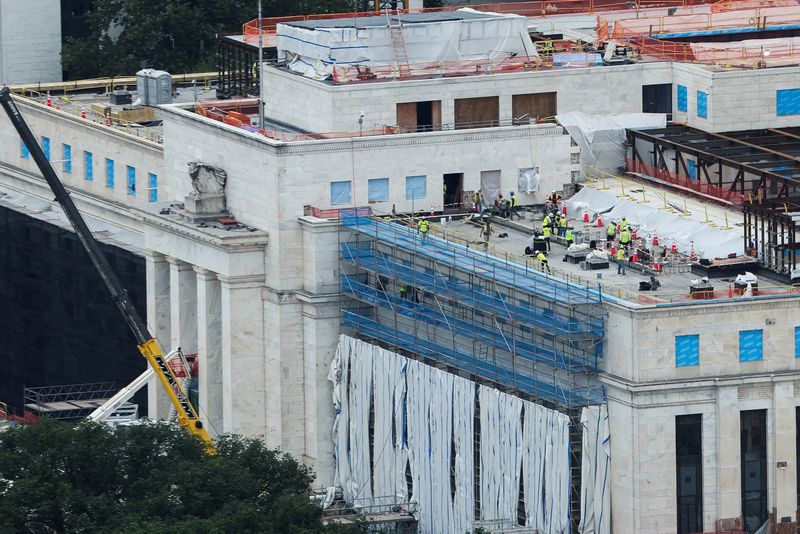
The Federal Reserve Board has shocked Washington, D.C.’s establishment and the nation with a breathtakingly self-indulgent spending program to “renovate” or “remodel” (I’ve seen both terms used) two of its three buildings in Washington, DC. First Question: Why does the Fed need three entire buildings to conduct its narrowly-focused, money-creation monetary policies? The Fed has been implementing a grossly expensive “renovation” project which has ballooned into a $2.5 Billion project. That is a total of $2,500,000,000!
Meme’s I’ve seen on computer links report that this amount exceeds the costs of building one or two football sports stadiums. The first link notes the obvious question that if the Fed can’t even manage a renovation project on its own buildings, how can it be relied upon to manage interest rates and the nation’s money supply? Some reports indicate the Fed is already $600 million over budget and the project is still ongoing. It is especially hard to justify how such an expensive overhaul of the Fed’s two buildings in question is needed when they were just renovated in 1999-2003 (second link). One Congressperson has called for a re-examination of the Federal Reserve Act (which created the Fed and gave it its independence). The Fed’s renovations will apparently be so opulent that the upgraded Fed facilities have been likened to the Fed’s new “Palace of Versailles.” The link notes that “real congressional oversight” of the Fed is needed.
Most people do not realize that the Federal Reserve Board is not a federal government agency. It isn’t a government agency at all; it is a private bank which was given a federal charter to manage the nation’s money supply and set interest rates. The initial decision must have been based on thinking that giving a private bank control of the nation’s money supply would take the politics of financial decisions out of the hands of politicians. The incredible self-indulgence on the part of the Fed indicates that maybe it should have its independence ended and it ought to be transferred to being a division of the Department of the Treasury. That would put accountability into the Fed’s decisions; currently there is little or no accountability on the part of the Fed to Congress or the president. President Trump’s displeasure with the Fed has been abundantly reported as Trump feels the Fed should lower interest rates (third link). Why doesn’t Trump simply fire Jerome Powell, the head of the Fed? He may not be able to do so since the Fed Chairman (and the employees and staff of the Fed) are not federal government employees. The term “federal” in the Federal Reserve’s name is deceptive as it gives the impression that it is part of the US federal government even though it is not discernibly a part of the federal government’s Executive, Legislative or Judicial branches. It is essentially, a “government within a government.” The Fed has a “federal” charter to control the nation’s money supply and interest rates so the word “federal” was placed into its name. That is my understanding of the Fed’s role in national governance.
Occasionally, Congress offers weak proposals to “Audit the Fed”, but Congress has never had the backbone to do such an audit. The self-indulgence of the Fed in its current spending on itself may finally move Congress to conduct an audit of the Fed’s activities. The fourth link reports that US Secretary of the Treasury Scott Bessent has called for a review of the entire Federal Reserve Board. Such a review is long overdue and it needs to have teeth in its review. Indeed, Chairman Powell of the Fed has already been criminally referred by a member(s) of Congress for perjury in his sworn testimony to Congress (fifth link). The Fed is becoming increasingly unpopular at both the White House and the Congress. As I write this post, I saw on a TV cable channel a clip of President Trump visiting the Fed buildings and having Fed Chairman Powell beside him. Trump is announcing that he has learned the Fed renovation project has risen to $3.1 billion as Chairman Powell shakes his head “no” as Trump speaks. Subsequent media reports stated Trump was including a $600 million renovation of the third Fed building a few years ago. I think Congress and the President need to ask Chairman Powell why the Fed has metastasized into such an immense agency with so many employees that it needs three Washington DC office buildings to house them all?
I will share a concern I have. Remember the secret nuclear war bunker at Mt. Weather that was built decades ago as a shelter for members of the government and Congress in case of a nuclear war? It was kept secret a long time, but is now public knowledge, and TV documentaries have been done about how its construction was kept secret as part of a major “renovation” of the resort/hotel it was adjoined to. Is something similar going on with the Fed’s “renovation” project? Maybe it is so wildly expensive because simply “renovating” the decor of the Fed’s offices isn’t the real purpose of the overall project. Renovating the Fed’s offices may be only a cover story. Perhaps the outlandish costs are due to one or two secret projects that may be underway inside the secretive Fed’s buildings. A secret nuclear war shelter project may already be underway somewhere inside the Fed’s buildings as part of this spending boondoggle. If this is so, is it being built with the cooperation of selected federal government officials who would also be sheltered inside such a super-bunker or is it just for the top officials of the secretive private bank called the “Federal” Reserve Board? The second possibility is that the Fed is building a very secret and well-concealed repository for a very large amount of gold over which the Fed would exercise sole control. To assert any US government authority over such a gold supply would require an act of Congress or a very strong president who will take decisive and forceful action in a dangerous time even if it is may be of debatable legality. We have such a president now. Having control over a large and secretive gold repository would be vital to backing a new currency after a major new war or a global financial crisis. If Congress ever finds the backbone to fully audit and investigate the Fed and its new building plans, they better have highly-trained investigators looking at all Federal buildings for hidden tunnels, compartments, etc. that are not shown on any blueprints. Again, the above commentary expresses some concerns of mine. These concerns have not been examined in public at all as far as I know.
What are the biblical prophetic implications of what is going on with the Fed’s building modifications and the financial climate we have today? The Fed is now under a critical spotlight of attention that It has never received in my lifetime. The results of this critical media attention on the Fed are not yet known. As I have discussed in posts and article over the years, Revelation 17-18 foretell that a major monetary/financial collapse will occur at some point in the latter-day sequence of events. Revelation 17:9-14 describe a future crisis wherein the merchants of the earth have plenty of goods and services to sell, but no one can buy their products. This aptly describes a global crisis wherein no one is sure what “money” has any value to use as a medium of exchange. Revelation 17-18’s prophecy indicates that the global banking/financial system will collapse due to war, a terrorist act, a systemic AI- or digitally-enabled attack on all financial data platforms or something else, but the prophesied collapse is clearly global in scope. My research report, Is “Babylon the Great” about to Fall…Ushering in a New “Beast” System,” explores many of the ways in which this biblical prophecy could be fulfilled. Since this prophecy describes a global financial collapse, it will affect all of us if we are alive when it occurs. Another research report of mine, The Babylonian Origin of the Modern Banking System reveals why the Bible calls the latter-day financial system, Babylon the Great.
- https://www.realclearpolitics.
com/video/2025/07/22/ned_ryun_ if_federal_reserve_wants_to_ spend_25_billion_on_ renovating_hq_how_are_they_ managing_monetary_policy.html - https://www.cnbc.com/2025/07/
14/fed-chair-powell-asks- inspector-general-to-review- controversial-building- project.html - https://www.washingtontimes.
com/news/2025/jul/17/ editorial-trump-grows- impatient-powells- extravagance/?utm_source= Boomtrain&utm_medium=manual& utm_campaign=newsalert&utm_ content=newsalert&utm_term= newsalert&bt_ee=% 2BkbPt8W3Lt2SVFC3oMUlPt3wsDbly OjafXQQ3YgbDeHArM0gmGL6asFpKU5 QJoXz&bt_ts=1753020723363 - https://www.cnbc.com/2025/07/
21/treasury-secretary-bessent- calls-for-a-review-of-the- entire-federal-reserve.html - https://www.vigilantfox.com/p/
jerome-powell-criminally- referred
