
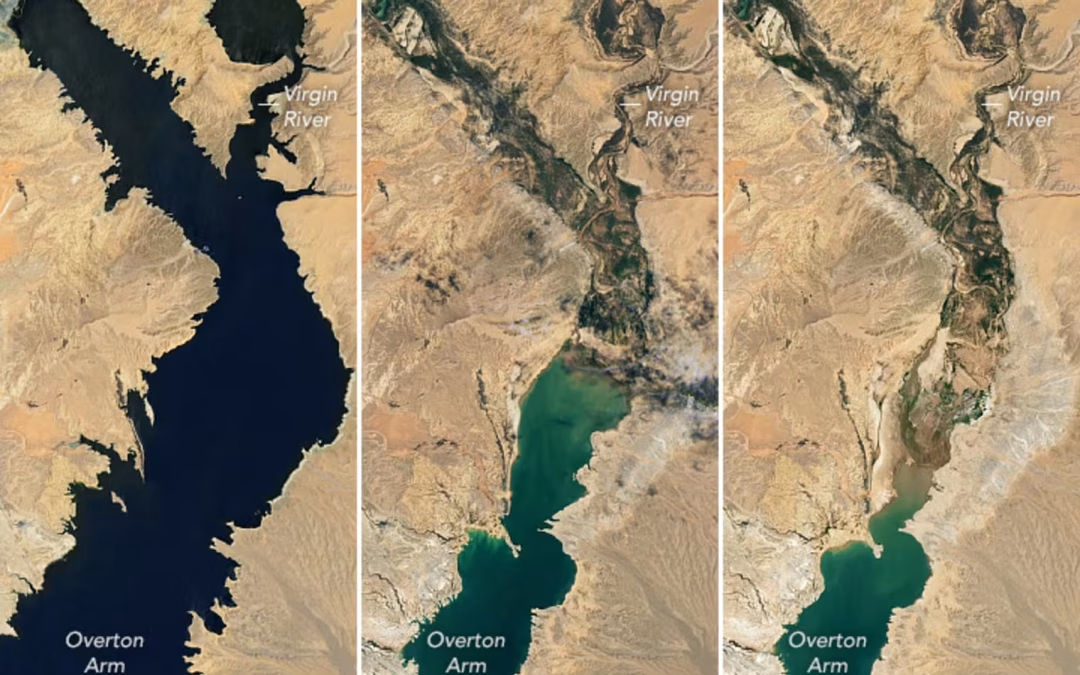
Readers of my posts know that I usually support my posts with a number of cited links in each of them. This post will be an exception to that standard practice. I have written several posts on the worsening drought crisis in the American Southwest states as this subject is becoming increasingly threatening to the USA with each passing month that this drought worsens. This crisis has been under-reported and under-appreciated, in my opinion. However, the September 4, 2026 issue of the USA Today had a very in-depth examination of the worsening Southwest drought in an 8-page insert in its “Weekend Extra” insert. It is entitled “A River in Retreat,” hence the title of this post about it. The insert is so comprehensive that it is not necessary for me to locate a number of links to provide documentation for this post. Some readers with access to a public library may want to read the article in a paper newspaper format.
My periodic posts on this topic have documented the worsening drought situation in the Southwest USA. This link below examines the crisis from political, environmental and historic perspectives. In documenting the extent of the crisis, the article states that “the April-July snow melt runoff season would end as the driest on record with just 15% of the average.” That is a major warning to the states, cities and tribal governments in the American Southeast to start taking extreme measures to cope with this existential threat to the economies and livability of the American Southwest. If that kind of super-low snowfall continues, the American Southwest will run out of surface water for human and agricultural needs. Snow melt calculations were revised slightly to leave 2022 as the record driest year, but the problem continues. For example, Lake Powell, an important reservoir for water supplies, is, according to the USA Today article, on the “brink.”
One problem is that Southwest states are not bearing the burden of scarce water equally. The Lower Basin states (Arizona, California and Nevada), which have the bulk of the affected population and agricultural usages for Colorado River water, have taken “the first and largest hit” of water reductions to date. However, these states are demanding that the Upper Basin states (Colorado, Utah, Wyoming and New Mexico) need to impose mandatory water use restrictions on their populations, a step “those states have resisted.” The article offers considerable details about how badly these water restrictions are needed and how politically difficult it is to make them. The American Southwest risks running out of electricity. Lake Powell, which produces much of the region’s hydroelectrical power, has dropped 170 feet in the last quarter century and is now only 37 feet above what is called the “minimum power pool” — the point at which the dam is so low on water that there will not be enough to produce any hydroelectric power. Lake Mead, the other main reservoir in the Colorado River basin, is also under threat in terms of its ability to provide water and electricity to the region. It is now likely that recreational uses of the Colorado River may have to end.
The era of cheap electricity for the region is ending. One city, Page, Arizona, is raising its electrical rates for residential customers by 20% and 40% for commercial users. The farms and 40,000,000 residents who depend on Colorado River water for drinking and for electricity will have to import electricity from elsewhere on the national energy grid, so just about everyone will be paying a lot more for electricity and water. The article quotes the Page, Arizona General Utility Manager, Bryan Hill, as stating that “this situation is dire.”
As the link points out, there is a strong possibility that a plethora of lawsuits will be filed as the states battle for “their share” of the diminishing water flow in the Colorado River Basin. As I see it, the respective legal rights of states and reservations to Colorado River water were adopted at a time when the flow of the Colorado River was much higher and more dependable. The users of Colorado River water are trying to assert their “rights” to water supplies that no longer exist. There simply is no longer enough water for everyone to claim their prior share of water in the Colorado River Basin. Clearly, a new agreement is needed before the situation becomes even more dire. The courts and/or Congress may need to step in to create new water allocations for everyone based on the current realities. As the link makes clear, the water use lawsuits are already in the preparation stages.
Every user of Colorado River water and regional snow melt will need to cut their water use. Hard decisions will need to be made. Agriculture is one of the major users of water, but can farmers switch to different crops that use less water? Can cities impose stricter water uses on their urban dwellers to use less water? How many golf courses will need to be shut down because watering them is a frill if people have no water to flush toilets or take showers? Cities may have to ration water to all citizens and shut off water supplies to scofflaws who flagrantly waste water. Why should any resident have the right to fill a private swimming pool in a time of severe water shortages? If this megadrought continues, very hard governmental and personal decisions will need to be made. One water use that can be stopped is now evident in light of news media coverage of the proliferation of data centers. Data centers reportedly use large amounts of water. When/if they are built, they need to be constructed in locations with ample water surpluses. Obviously, there is no “ample water surplus” anywhere in the Colorado River Basin. At minimum, the seven states in the Upper and Lower Colorado River Basin region should have moratoriums on building any data centers on their lands. Recognizing such a reality will lead to more political struggles. Indeed, all states and regions which have current droughts (and there are many), should not even consider a Data Center due to its high water demands.
The article also discusses the fact that many governmental entities are fighting for an ever-decreasing amount of water. Because the legal claims upon the Colorado River’s water exceed the supply of water, the courts will have to decide many conflicting demands upon the scarce water resources. Since the conflicting claims are all legal, each claimant feels like “We’re fighting for our own water.” The American drought is spreading. Many Midwest states are in drought zones and Puerto Rico, an American Commonwealth, is already rationing water to its citizens.
As I’ve noted in previous posts, the Bible records that the Creator God does make an effort to get mankind’s attention sometimes via environmental hardships. Deuteronomy 28 lists the blessings that flow from obedience to God’s laws and ways while also listing curses that will come as a result of a nation’s prolonged disobedience. Verses 23-24 specifically list severe droughts as one method that God will use to try and induce nations to repent. Matthew 24:7 echoes these verses in which it prophesies that “famines” will be a sign of the latter day afflictions upon an unrepentant mankind. Severe droughts inevitably result in famines (a lack of food).
The USA Today insert notes that American states and other jurisdictions are now dealing with “previously unimaginable aridification.” Few consider that the source of our unprecedented drought may be the Creator God Himself — who may be trying to get America’s attention. Have any state governors, mayors or tribal leaders called for people to pray to God for relief from the worsening drought? If this super drought is being sent by God Himself, people need to pray for relief for sure, but they also need to repent of disobeying or ignoring God’s laws and biblical ways of life. God is immortal. He has all the time in the world to wait for mankind to repent and return to him. Mankind does not have that luxury. Our lifespans are short so our national need for repentance is time-limited. I urge readers of this post to be intercessors for our people to repent and receive needed rainfall. James 5:16-18 tells us the prayer of just one person can affect the course of nations. It cites the precedent of Elijah praying for a drought and, years later, for rain to return again. God answered both his prayers. I think that it is noteworthy that this example of one person’s prayer pertained to circumstances of drought and rainfall.
https://www.pressreader.com/usa/usa-today-us-edition/20260904/282054808905876
