
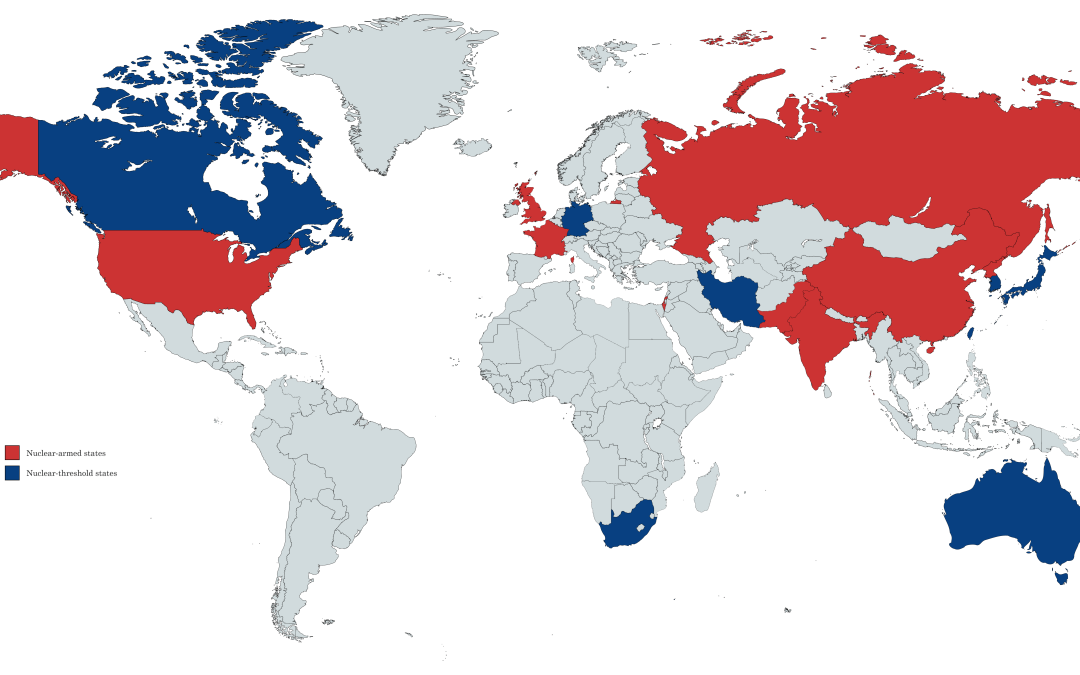
As readers likely know, the “nuclear club” refers to nations that have nuclear weapons. Many nations have wanted them over the decades since they were invented. Some have obtained and deployed them, but most nations have not. It takes technological sophistication and a ready source of uranium or plutonium to make “nukes.” This post will discuss which nations may have nuclear weapons (or soon will have them). Given the stresses and wars in global geopolitics, it is likely that some nations will ignore the Nuclear Non-Proliferation Treaty due to the overriding need to protect their nations from nuclear-armed aggressors.
The first link offers good insights on the growing pressures on many nations to develop their own nuclear weapons. It focuses on an agreement between Russia and Ukraine that was implemented after the break-up of the USSR. Ukraine originally inherited a certain percentage of the USSR’s nuclear weapons, but they (foolishly) relied on international guarantees that they could give their nukes to Russia for “dismantling” and that Russia would recognize Ukraine’s borders. Russia invaded Ukraine in 2014 and 2022, and the world community has not forced Russia to keep its agreements. In retrospect , Ukraine should have kept its share of Soviet nukes. If it had done so, Russia would surely have not invaded Ukraine. The Russian invasion of Ukraine has made it painfully obvious that if non-nuclear nations want to protect themselves from nuclear-armed nations, they must have nuclear weapons of their own. This reality begs two questions; Did Russia really dismantle and destroy the Soviet nukes that Ukraine sent to it, and did Ukraine really give all its nukes to Russia or did it retain some for an ultimate defense option? The link lists the current known members of the Nuclear Club as the USA, Russia, the UK, France, China, India, Israel, Pakistan, and North Korea.
There are a number of nations that now urgently need nuclear weapons of their own as they are endangered by hostile, nuclear-armed nations and the reliability of the “nuclear shield” offered by the USA, the UK and France may not be sufficient for national protection. The second link focuses on the vulnerability of South Korea as it is threatened by nuclear-armed Russia, China and North Korea. It cites “alarm” in South Korea about the reliability of the American nuclear shield over South Korea in light of current world events. The third link reports that Poland’s government is inviting the USA to base American nuclear weapons on Polish soil as an added deterrence to a Russian invasion. The fourth link has a surprising admission. It states that after the Russian invasion of Ukraine in 2022, “the then leader of Poland’s governing party has stated he would like Poland to acquire nuclear weapons…” Poland is bordered by Belarus (a Russian vassal), and Kaliningrad, a Russian enclave. Seeing that Russia felt emboldened to invade Ukraine, a non-nuclear nation, Poland’s desire to have nuclear weapons of its own is obvious. The fifth link relates that Poland now has a plan for intensive military training for all its male citizens so the Polish army could be quickly scaled up to 500,000 soldiers with little notice. Poland has been beefing up its conventional military force for years, purchasing many weapons platforms from the USA and South Korea.
As readers no doubt know, US President Trump has been urging and/or demanding that European NATO nations spend much more on building up their own military forces to protect the NATO nations. Trump pushed such actions in his first term, and has intensified it in his second term. Most nations (with the notable exceptions of Poland and the Baltic nations) largely ignored Trump. Now that Trump’s second term is beginning with the very dangerous and costly Ukraine-Russian war in its third year, more European nations are paying attention to their need to increase their military forces substantially. President Trump is now getting his way.
Germany has been one of the laggard nations when it comes to their national defense. On a percentage of GNP basis, Germany, France, the UK, Italy and Spain have all been largely ignoring their need for funding serious military forces. Germany may be coming out of its slumber on this matter. Germany recently had an election and the presumptive new Chancellor, Friedrich Merz, is considering a “nuclear-sharing” agreement with fellow NATO members France and the UK (sixth link and seventh link). Would such a nuclear-sharing agreement transfer control of some of the British and French nukes to German control? Russia would be passionately against such an option, but Russia invited such a possibility when it invaded Ukraine, a non-nuclear nation. I think the realization is growing throughout the world community that there are two classes of nations: nuclear-armed nations and those who have no nuclear arms. The Russian invasion of Ukraine has made it blindingly obvious that nuclear-armed nations can be predator nations while non-nuclear nations can be seen as prey.
South Korea, Japan and Taiwan are nations which are located in the same region of the world and all three are threatened by Russia, China and North Korea. Unless they have nuclear weapons, they can be seen as prey nations. Let’s consider South Korea first. The eighth link and ninth link examine the likelihood that South Korea has partnered with the UAE for years to jointly develop nuclear weapons. There is no doubt that South Korea has the technology to easily assemble nuclear weapons and that the UAE has the money to bankroll such a project. South Korea has to protect itself from Russia, China and North Korea, and the Sunni UAE has need of a nuclear program to counter Shiite Iran’s program to develop nuclear weapons. It would not surprise me at all if South Korea and the UAE joined the Nuclear Club years ago, but have chosen to remain silent about it (at least publicly).
The tenth link examines the likelihood Japan has nuclear weapons already. Japan also has the technology and access to uranium/plutonium to build nuclear weapons. I have cited in my blog posts the opinions of other sources who have asserted that Japan actually has the nuclear warheads built and that it only needs to affix those warheads to rockets and missiles to have a substantial number of nuclear weapons almost “overnight.” Nuclear bombs delivered by aircraft would be quite feasible. Japan is a special case because its post WW-2 Constitution was a pacifist document but allowed for self defense. Threatened by nuclear armed Russia, China and North Korea, Japan has an obvious need for a significant number of nuclear weapons to deter aggression against Japan. Needing only minutes to fully attach nuclear warheads to delivery platforms to have functional nuclear weapons, Japan has been likened to being only “a screwdriver’s turn” away from being a major nuclear power. I believe that describes Japan’s situation rather well.
What about Taiwan? It badly needs a nuclear deterrent of its own to minimize the risk of an attack by China. One hears very little about Taiwan’s efforts to prepare for a Chinese attack. When the USSR collapsed in 1990, there was much talk for awhile about “loose nukes” because, reportedly, Soviet generals were not being paid any longer and they sold Soviet nukes to pay themselves and their troops. Some nukes were larger, but there were also reports of suitcase nukes being sold on the black market. That would have been an ideal time for Taiwan (or anyone else) to obtain nukes without any publicity. Taiwan would have had every motivation to obtain nukes at that time without having to build a visible nuclear weapons infrastructure. While doing research for this post, I came across an interesting piece of information about Taiwan and nuclear weapons. I have a book entitled, The Nuclear Axis, by Barbara Rogers and Zdenek Cervenka. This book bears a copyright date of 1978. While focusing on the efforts by South Africa’s Apartheid government to obtain nuclear weapons, it also details many clandestine efforts by Israel and other nations to build nuclear weapons. It names the national and international leaders who had roles in clandestine nuclear weapons programs around the world. On page 272 it asserts that there were five nations which were considered then to be “near nuclear states.” One was South Africa which later admitted it had a small number of nuclear warheads, but later chose to dismantle them. I still have a newspaper article from the April 8, 1995 Sioux Falls Argus-Leader, which reprints an AP source that “Former President F.W. de Klerk revealed [that]…the six bombs that had been constructed were dismantled.” Were they really dismantled or is South Africa still a small nuclear power (eleventh link)? We do not know. Now back to Taiwan.
The above-mentioned 1978 book includes this statement on page 272: “Considering that at least three states–Israel, Taiwan and India–are generally accepted as being already in possession of nuclear explosives...” (Emphasis added). If this statement was accurate in 1978, it means Taiwan has been a member of the Nuclear Club for over four decades. If true, Taiwan isn’t saying how many nukes it has manufactured (or bought) over the decades. It is a high-tech nation that can easily design and make nuclear weapons, so why wouldn’t it do so given the extreme threat it faces from China?
The above information has biblical relevance. Jesus Christ prophesied in Matthew 24:22 that “except those days should be shortened, there should no flesh be saved.” He was referring to the latter days preceding his Second Coming in that chapter so his statement indicates his return will occur earlier than expected on latter-day timetables. The phrase “no flesh should be saved” is instructive. This prophetic statement means not just all humans would be destroyed, but also that all animals, birds, fish, amphibians, reptiles and anything made of “flesh” would perish in a planetary destruction. A global nuclear war could turn into an Extinction Level Event. I’m not predicting that prophecy will be fulfilled by a massive nuclear war, but it is one realistic possibility. There may be a significant number of nations which are now members of the Nuclear Club, but they have not admitted or proclaimed it in the interests of maintaining secrecy.
The Apostle Paul was right on target when he prophesied in II Timothy 3:1 that the latter days of our current age would be “perilous times.”
- https://asiatimes.com/2025/
02/the-nuclear-consequences- of-ukraine-losing-the-war/? utm_source=The+Daily+Report& utm_campaign=37c4733e71-DAILY_ 27_02_2025&utm_medium=email& utm_term=0_1f8bca137f- 37c4733e71-31566629&mc_cid= 37c4733e71&mc_eid=8ba140d851# - https://asiatimes.com/2025/03/
alarmed-by-trump-south-korea- mulls-japan-style-nuclear- latency/?utm_source=The+Daily+ Report&utm_campaign= fc1894f1bd-DAILY_17_03_2025& utm_medium=email&utm_term=0_ 1f8bca137f-fc1894f1bd- 31566629&mc_cid=fc1894f1bd&mc_ eid=8ba140d851# - https://apnews.com/article/
poland-duda-nuclear- 52c2d921645154539a7778b11d9255 4b?user_email= 1bb5bae2fa018f8f383f58bb0f5029 8e01b91f994fbe23068ed7dcf86c4c 9509&utm_medium=Morning_Wire& utm_source=Sailthru_AP&utm_ campaign=Morning%20Wire - https://en.wikipedia.org/wiki/
Poland_and_weapons_of_mass_ destruction - https://www.bbc.com/news/
articles/cy83r93l208o? at_campaign_type=owned&at_ medium=emails&at_objective= awareness&at_pt_type=email&at_ pt_name=Salesforce&at_ campaign=newsbriefingpm&at_ email_send_date=20250311&at_ send_id=4306787&at_link_title= https%3a%2f%2fwww.bbc.com% 2fnews%2farticles% 2fcy83r93l208o&at_bbc_team=crm - https://www.aa.com.tr/en/
europe/possible-next-german- chancellor-does-not-rule-out- nuclear-sharing-talks-with- france-uk/3489288 - https://www.euractiv.com/
section/politics/news/merz- considers-extension-of-french- british-nuclear-umbrella-to- germany/ - https://stevenmcollins.com/
are-south-korea-and-the-uae- partners-in-building-nuclear- weapons/ - https://stevenmcollins.com/
secret-nuclear-cooperation- between-south-korea-and-the- uae/ - https://stevenmcollins.com/
does-japan-already-have- nuclear-weapons/ - https://isis-online.org/
publications/southafrica/ ir0594.html
